TanzaniaPrivateLodge
8-Day Great Migration Safari
8 days · 7 nights
You visit: Tarangire, Serengeti, Ngorongoro
Explore moreWhere the herds usually are in each part of the year, what you are likely to see, and why we plan your Serengeti nights around your travel month.
By Noreen Godfrey Kirimbai ·
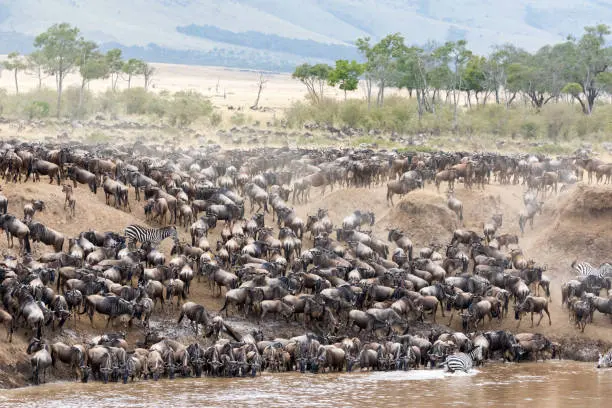
Every year, well over a million wildebeest, together with large numbers of zebra and gazelle, travel a great loop through the Serengeti ecosystem and into Kenya's Masai Mara. They are not following a calendar. They are following grass and water, and grass and water follow the rain. That is the single most important thing to understand before you book a migration safari.
What follows is the broad pattern we see from our base in Arusha, season after season. Use it as a guide to the shape of the year, not as a timetable. When you tell us your travel month, we look at where the herds have been, how the rains have behaved and which camps put you closest, and we build your route from there.
After the short rains, the short-grass plains of the southern Serengeti and the Ndutu area, on the edge of the Ngorongoro Conservation Area, turn green and rich in nutrients. The herds spread out across this open country, often as far as you can see in every direction.
Calving usually happens from roughly late January into February, when a very large number of calves are born within a few weeks. It is one of the most remarkable things you can witness on safari: wobbly calves on their feet within minutes, and lion, cheetah and hyena never far away. For photographers and anyone interested in predator behaviour, this is often the most rewarding time of the whole cycle.
The southern plains are wide and largely treeless, so sightings can be long and uninterrupted. Expect warm days, the possibility of afternoon showers and spectacular skies.
The long rains usually arrive around April and May. As the southern plains begin to dry out after the calving season, the herds start moving north-west through the central Serengeti, sometimes in long columns that stretch for kilometres.
This is the quietest time of year in the parks. Some camps close for a few weeks, roads can be muddy and you should expect rain on most days, often as heavy afternoon downpours rather than all-day drizzle. In return, you get lush green landscapes, very few other vehicles and lower rates at many lodges. It suits flexible travellers who do not mind a little weather and want the Serengeti to feel their own.
As the dry season begins, a large part of the migration typically pushes into the Western Corridor, the long finger of the Serengeti that reaches towards Lake Victoria. Here the herds meet the Grumeti River, which has pools rather than a strong current at this time of year, and which is home to some very large crocodiles.
Grumeti crossings are less famous than the Mara crossings, but they can be dramatic, and the area is generally quieter. Wildebeest rutting season also tends to fall around this period, with males noisily competing for territory and females.
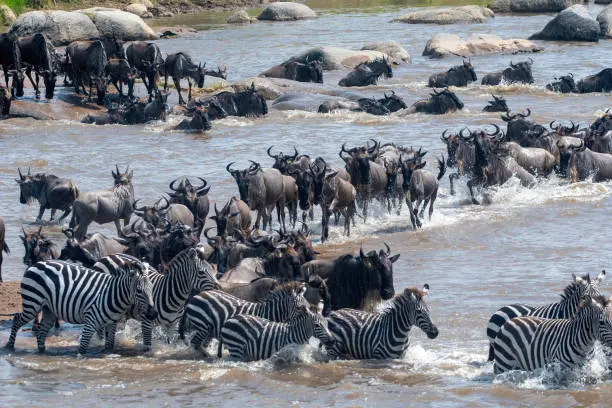
From around July, the herds usually reach the northern Serengeti and the Mara River. This is when the crossings people see in documentaries happen: thousands of animals gathering on the bank, hesitating for hours, then suddenly plunging in all at once. Some crossings last minutes, others go on for much longer.
Part of the migration continues across the border into Kenya's Masai Mara National Reserve, where it often spends the late dry season before turning back. If you would like to see the migration on both sides of the border, we can combine the northern Serengeti with the Masai Mara in a single journey.
A word of honesty: crossings cannot be guaranteed. Herds can wait at a river for a day and then turn away. The best way to improve your chances is to spend enough time in the north, with a guide who is patient and knows where to wait. That is why we usually recommend at least three nights in the right area rather than a quick visit.
This is also the busiest period in the northern Serengeti, so we choose camps and timings that keep you away from the crowds where possible.
With the arrival of the short rains, usually around November, the herds begin drifting south again through the eastern and central Serengeti, heading back towards the fresh grass of the southern plains. By December the cycle starts again.
November can be a lovely shoulder month: the landscape turns green, the herds are on the move and visitor numbers are lower than in the peak months.
If the short rains come early, the herds may arrive in the south sooner. If the long rains are late or patchy, the move north can be delayed, or the herds may split into several groups spread across different parts of the park. A heavy local storm can pull animals in an unexpected direction within days.
This is why we never sell a fixed migration departure and promise it will match the herds. Instead, we route by your travel month. Close to your travel dates, our guides and partners in the field tell us where the animals are, and we place your nights accordingly. Our private vehicles also mean your guide can change the plan for the day without waiting for anyone else.
Our 8-Day Great Migration Safari is built around three nights in the Serengeti, moved seasonally with the herds, with Tarangire before and the Ngorongoro Crater after. If you would like the full picture of the park first, read our Serengeti destination page, and for the northern crossings and Kenya, have a look at the Masai Mara.
Whatever month you have in mind, tell us your dates and we will tell you honestly where the herds are likely to be and how to make the most of it.
Further reading
Related trip
8 days · 7 nights
You visit: Tarangire, Serengeti, Ngorongoro
Explore moreRead next
Three routes to the Roof of Africa, each with its own scenery, crowds and acclimatisation profile. Here is how to choose the one that suits you.
Read the notePlan with us
Every itinerary is drawn by hand in our Arusha office — routing, pacing, camps and honest budget ranges. One conversation is usually enough to know whether we're the right fit.